
In hardly any other industry do complexity, volume and time pressure come together as directly as in steel and metal processing. Slabs, coils or heavy plate sheets weighing tons must reach the right process step at the right moment, while tight Manufacturing windows and a high variety of variants put additional strain on plant logistics. At the same time, customers today expect on-time delivery to the exact point—and plants increasingly need to create digital transparency at full capacity without interrupting operations.
The framework conditions have changed significantly in recent years. Markets have become more volatile, products more customized, and system landscapes more complex. At the same time, the shortage of skilled workers in the steel industry is real and tangible.
“After more than three decades of digitalization experience, we can see very clearly that this increasing market, product and system complexity can no longer be managed by hiring additional staff. What is missing today are automation, transparency and an overarching control logic.”
Christian Hiebl, COO, ABF GmbH
This is particularly evident in intralogistics. When material positions are unclear, cranes or forklifts compete, or priorities change at short notice, even a well-organized operation can quickly slip into reactive mode.
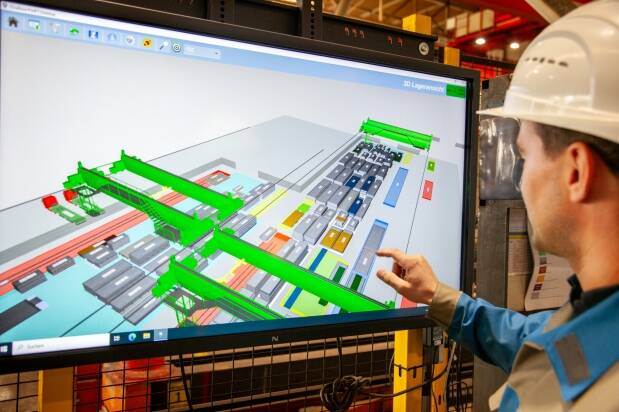
This is exactly where the intralogistics suite OneBase®MFT from ABF in Linz—the digitalization specialist for Manufacturing and intralogistics—comes in: it combines modern locating technologies, automated posting mechanisms and intelligent optimization into a system that not only makes material flows visible, but actively controls them. What used to be based on experience, paper slips or the assessment of crane and forklift operators is now a precise, digitized process—even in plant environments that have grown over decades.
From searching to digital material transparency
How great the operational effort can be without digital support was evident for a long time at the voestalpine form cutting center in Linz. There, hundreds of heavy plate sheets are stored stacked on top of each other every day. To provide the required piece of material for Manufacturing in the next shift, picking teams often searched for the right plates for hours. Sheets were marked with colors, stacks were uncovered and prepared so that crane personnel could remove them specifically—considerable manual effort that was necessary to avoid costly production downtime.

Similar situations were also found in other warehouses that ABF has already optimized with its intralogistics solution, for example at Salzgitter Mannesmann Grobblech GmbH. Manual cranes, high stacks and complex storage logic also required very close coordination there—often driven by the experience of individual employees.
RTLS as the foundation for automatic material tracking
With the introduction of OneBase®MFT, this picture changed fundamentally. For the first time, the solution made every single piece of material digitally visible. The system automatically records the positions of materials and transport equipment, detects load changes, documents inbound, relocation and outbound movements seamlessly, and provides all data in real time. The digital twin creates exactly the foundations that steel-processing companies need: the right information at the right time—without manual intervention.
The technical basis of these solutions is precise real-time locating (Real-Time Locating System, RTLS). ABF has relied on RTLS technologies for more than 15 years and is deliberately technology-agnostic. Depending on the environment, GNSS, radar or 2D/3D LiDAR are used. RTLS in combination with load sensors makes transport equipment and loads clearly locatable; material movements are automatically posted without barcode scans.

While radar-based RTLS systems play to their strengths particularly in robust crane locating in the harsh steelworks environment, state-of-the-art 3D LiDAR technology is especially compelling for ground vehicles thanks to infrastructure-free locating indoors and outdoors. The manual transport equipment remains—but it becomes a transparent and controllable resource.
The result: search times disappear, color markings become unnecessary, and unnecessary relocations are reduced. This saves real money in every warehouse.
When transparency alone is not enough: material flow control at Georgsmarienhütte
In highly dynamic environments, however, transparency alone reaches its limits. This is shown by the ABF project in the finishing operation of Georgsmarienhütte GmbH, where bar steel material is stored for further processing at various production units as well as for subsequent shipping. On around 130,000 m², cranes, side loaders, narrow-gauge railways as well as truck and rail traffic move around. Different transport requirements constantly compete with one another, while chaotic storage and changing production requirements create additional complexity.

Before digitalization, many decisions were made locally: Which crane takes which job? Where is material temporarily stored? Which movement has priority? This inevitably led to waiting times, unclear priorities and inefficient transports.
With the introduction of material flow control from OneBase®MFT, not only was an RTLS-based warehouse management system established, but also an overarching coordination for the first time. Transport orders are no longer optimized in isolation, but in the context of the entire plant. The integrated OneBase® Intelligence assesses urgency, detects bottlenecks early and automatically generates transport orders in the background—without manual intervention and without additional coordination effort.
Automatic cranes: AI-supported coordination on a crane runway
This approach goes even further in fully automated coil warehouses, for example in the Steel Service Center of Schütz GmbH or Wupperman AG. There, ABF operates automatic crane systems with its intralogistics powerhouse including control and safety technology. Especially when several cranes work on a shared crane runway, this quickly becomes a scenario that can lead to conflicts without intelligent coordination.

This is where AI-based Crane Scheduling can make the difference. The software calculates optimal travel paths in real time, distributes jobs and handovers between cranes, avoids collisions and at the same time takes production and shipping priorities into account.
Compared to classic, rule-based approaches, the AI achieves up to 25% higher performance because it plans ahead, evaluates alternatives and continuously optimizes. The result is synchronized interaction—without downtime, without mutual blockages.
Conclusion: the optimized transport fleet as the key to efficient intralogistics
“The projects implemented by ABF show: Innovative technologies such as real-time locating systems now enable the digital twin through automated material tracking, and intelligent systems ensure stable, optimized material flows—even under high complexity. This delivers the transparency and performance that modern warehouses need.“
Christian Hiebl, COO, ABF GmbH


