
Simulation with Artificial Intelligence
Sustainable and efficient warehouse and production processes through precise, digital simulations.
- Efficient and safe processes
- Early risk detection
- Time and cost savings
- Reduced downtimes
- Long-term future security of the WMS and MES

OneBase®Intelligence for Manufacturing
Automatic fine planning and machine learning
The method portfolio for order scheduling was specially developed for the optimization of multi-stage Manufacturing processes.
- Up to 25% performance optimization
- Reduced planning times
- Combined simulation and optimization
- Transparent, data-driven decisions
OneBase®Intelligence in intralogistics
Higher storage capacity and efficient crane control
OneBase®Intelligence offers numerous tools for optimization, simulation and testing in the field of material flow control:
- Integrated AI methods
- AnyLogic integration with OneBase®MFT
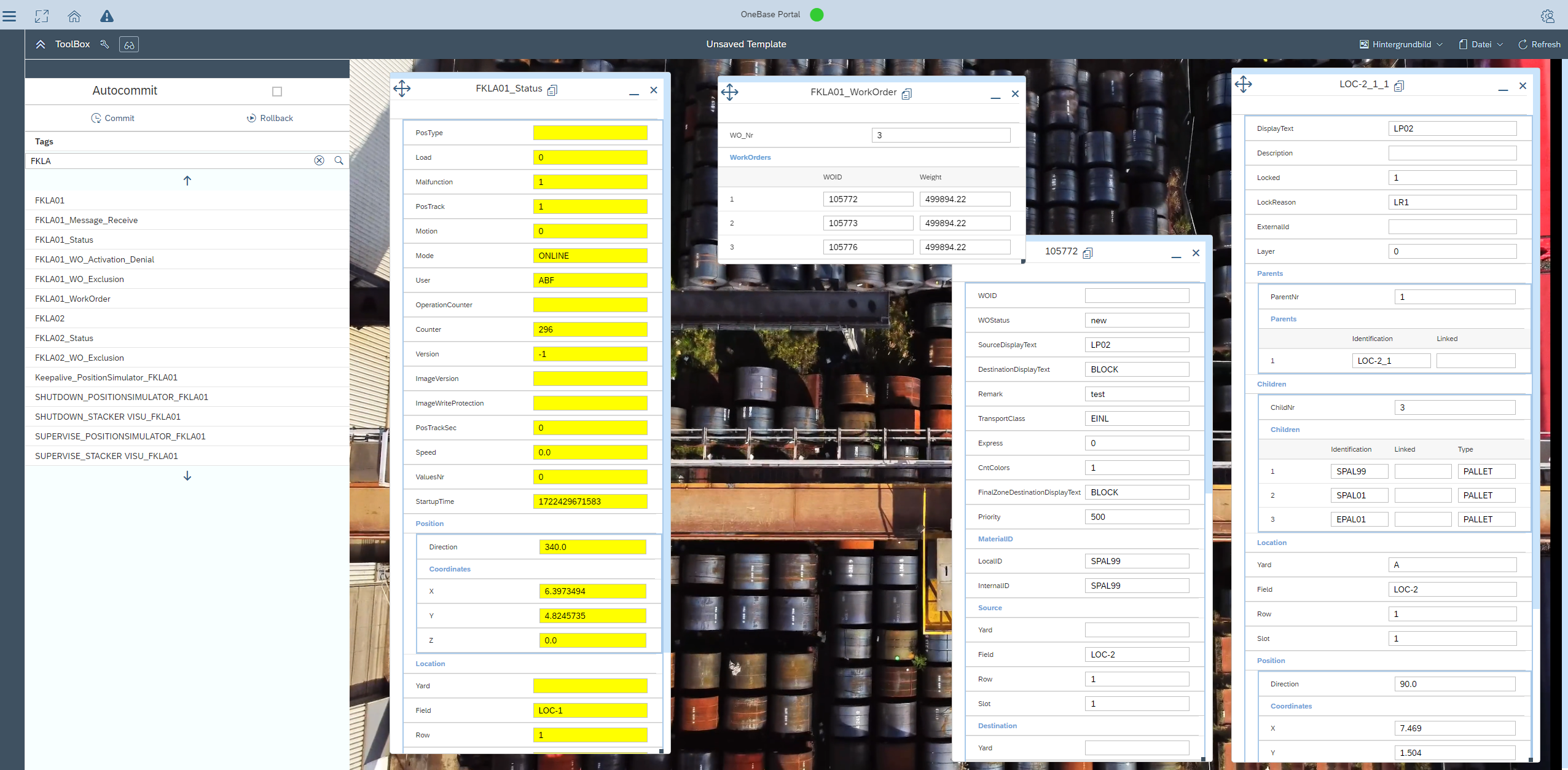
- OBPortal for live data visualization
- OBFormula for the configuration of simulation cases

Efficient and reliable processes in the warehouse and in Manufacturing are the result of precise processes – and these are achieved through early simulation, continuous optimization, and regular testing.
With the help of modern simulations, complex process chains can be digitally mapped, tested, and optimized – without disrupting ongoing operations. This allows deviations to be identified early, risks to be avoided, and the efficiency of processes to be sustainably increased.
Milena Lengauer
Head of Software Product Design
ABF GmbH
Key Benefits
- Evaluation of changes in plant, crane, and transport system configurations
- Analysis of warehouse layout, topology, and material flow (input and output)
- Consideration of production plans and relevant influencing factors
- Detection of bottlenecks and inefficient processes
- Development and validation of optimization concepts
- Optimized planning and execution of transport and production orders
- Assessment of planned measures regarding their effectiveness
- Support in the implementation and commissioning of improvements
Showcases of Artificial Intelligence
These practical showcases demonstrate how simulation and AI work together to significantly increase efficiency, predictability, and process reliability.
Crane Scheduling
This practical example has a tactical component: How can the next 10–20 crane movements be planned to create the most efficient material flow possible?
The solution is achieved through numerical simulations and heuristic optimizations – essentially through “intelligent trial and error”.
In numerous simulation runs, different movement sequences are evaluated and optimized with regard to throughput and waiting time.
Result:
Up to 25% increase in efficiency in processing
Significantly reduced downtimes and waiting times
Adaptive decision logic for changing process situations
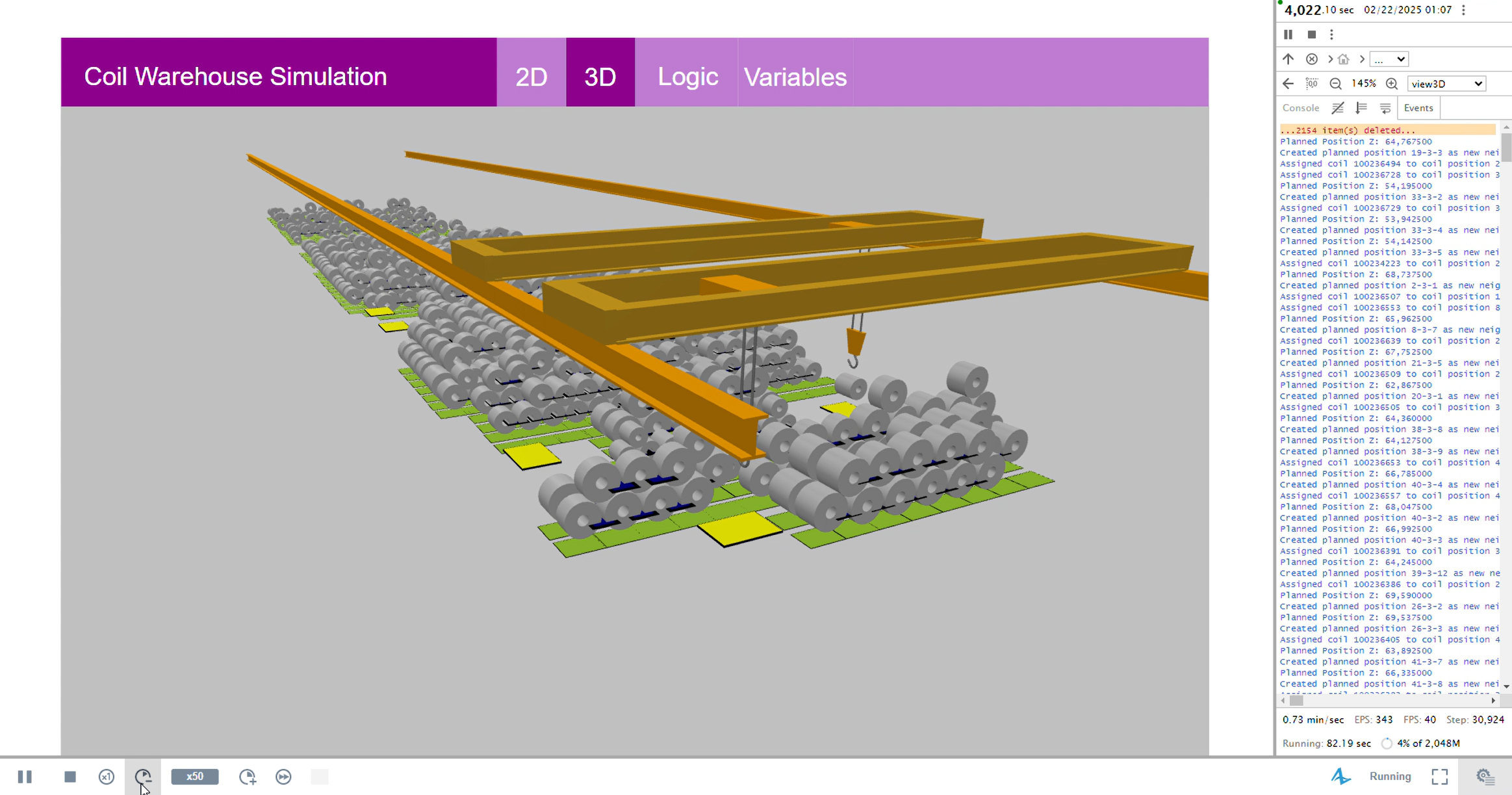
Location Assignment Problem (Space Allocation)
This specific application deals with the strategic level of warehouse logistics: Where should a coil or piece of material be stored so that later retrievals are possible without complex re-stacking?
The system uses historical storage and retrieval data to realistically play through various scenarios in an offline simulation. For this purpose, clearly defined KPIs are used, which map optimal and undesirable storage conditions. These key figures are intelligently weighted and automatically optimized in numerous simulation runs – supported by the powerful AI-based optimization framework Optuna.
Result:
Reduction of re-stacking and blockages
Increase in storage density and access efficiency
Sustainable improvement of overall logistics

AI in Manufacturing – Fine Planning Automatically and Simulated
Our methodology portfolio for Order Scheduling is specifically designed to simulate multi-stage Manufacturing processes and continuously optimize them for automatic planning.
Current situation
- Planning functions strongly dependent on project-specific technologies
- Standard control station functions often insufficient for individual requirements
- High dependence on experienced dispatchers
Challenge
- Complex dependencies between machines, plants, and processes
- Initial decisions significantly influence later work steps
- Search for a flexible, learning planning system
Goal and benefit
- Combine simulation and optimization
- Generic solution, adaptable for various production processes
- Reduced planning times and higher system efficiency
For automatic fine planning with AI methods, state-of-the-art optimization methods are used – including construction heuristics, intelligent decoding and evaluation processes, metaheuristics, neighborhood analyses, and simulation-supported decision logic.
This results in a performance optimization of up to 25%